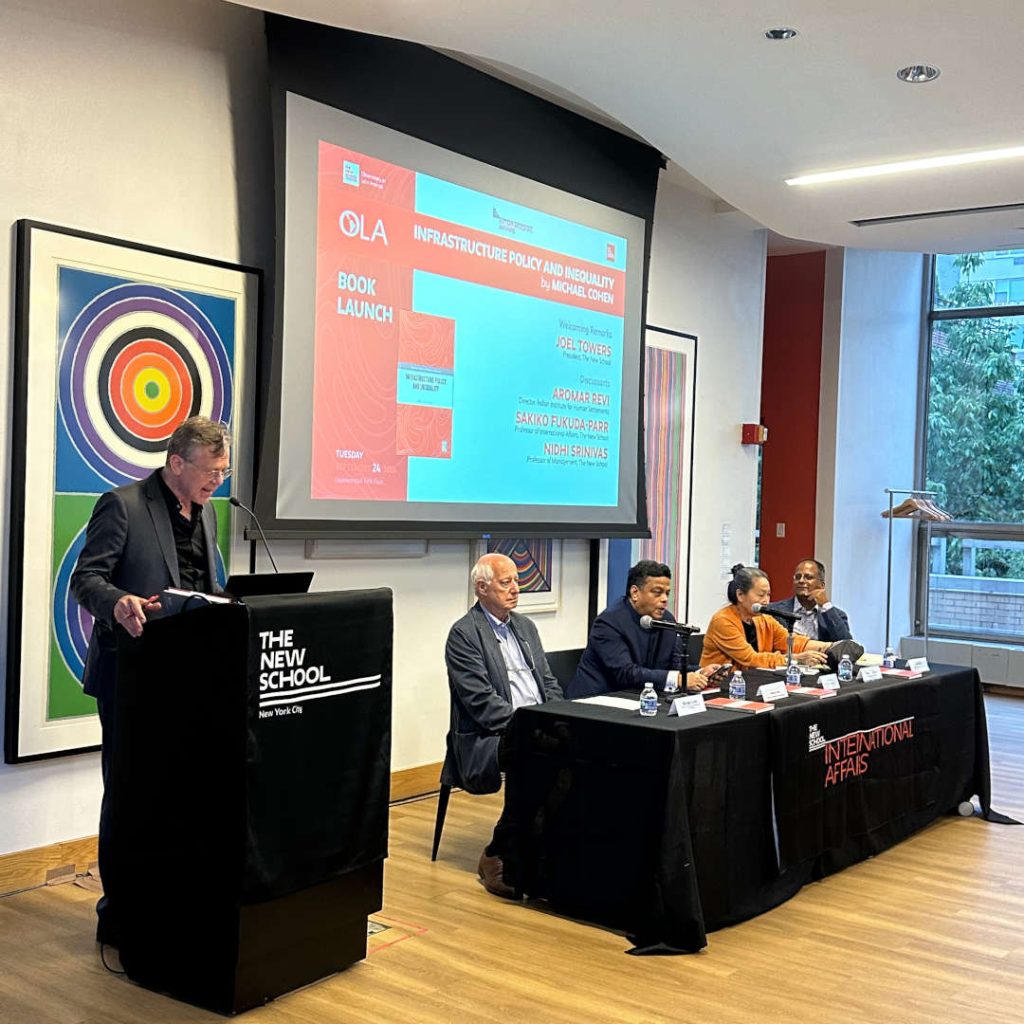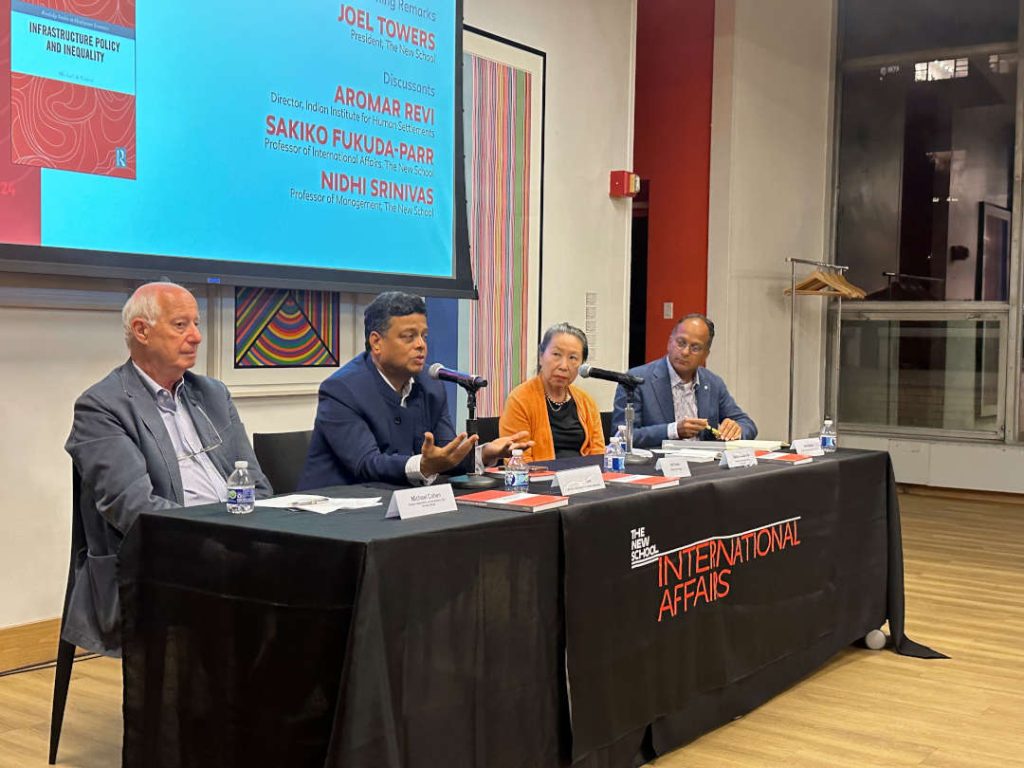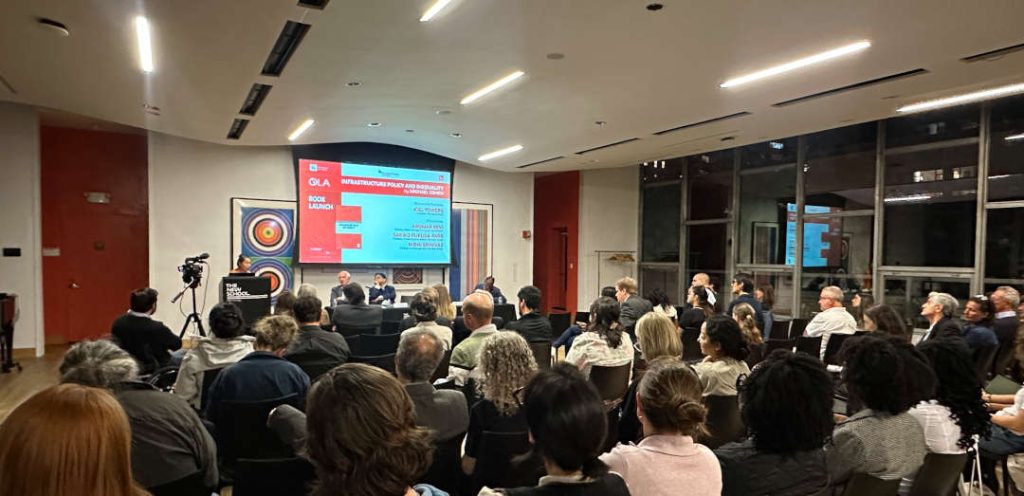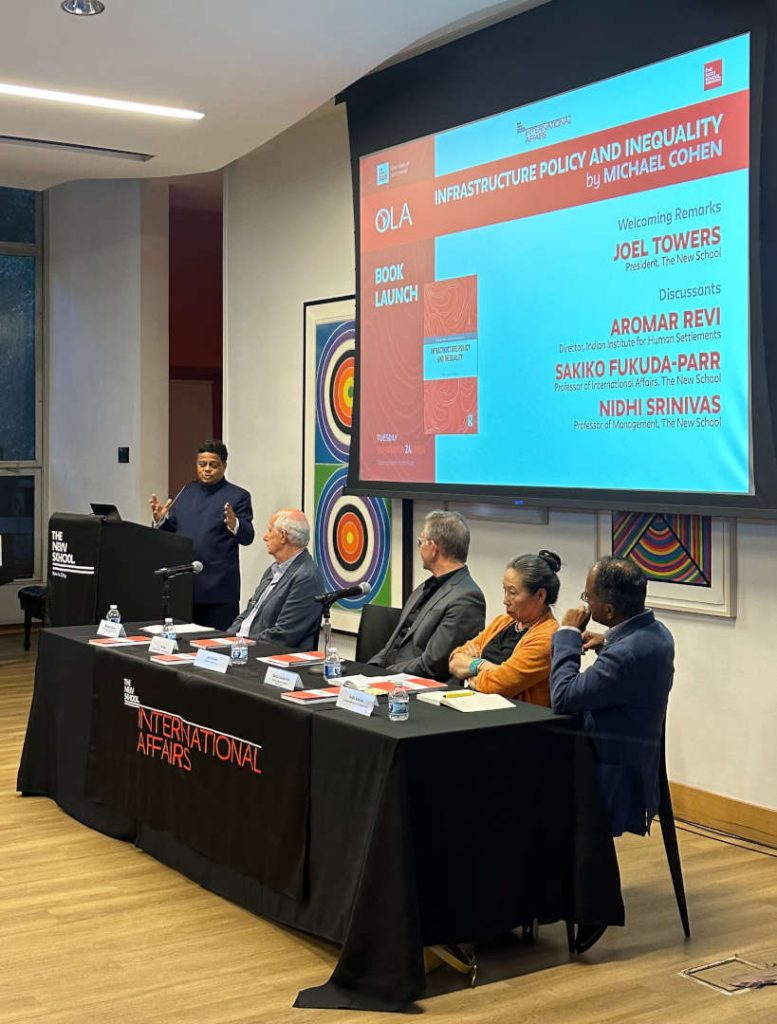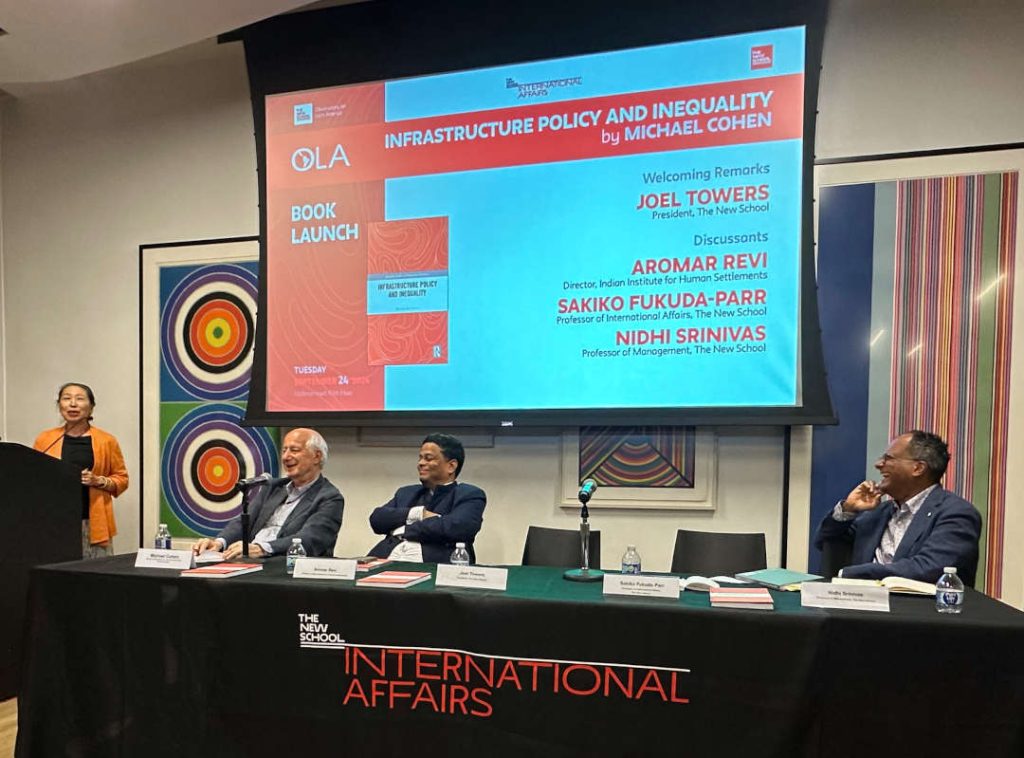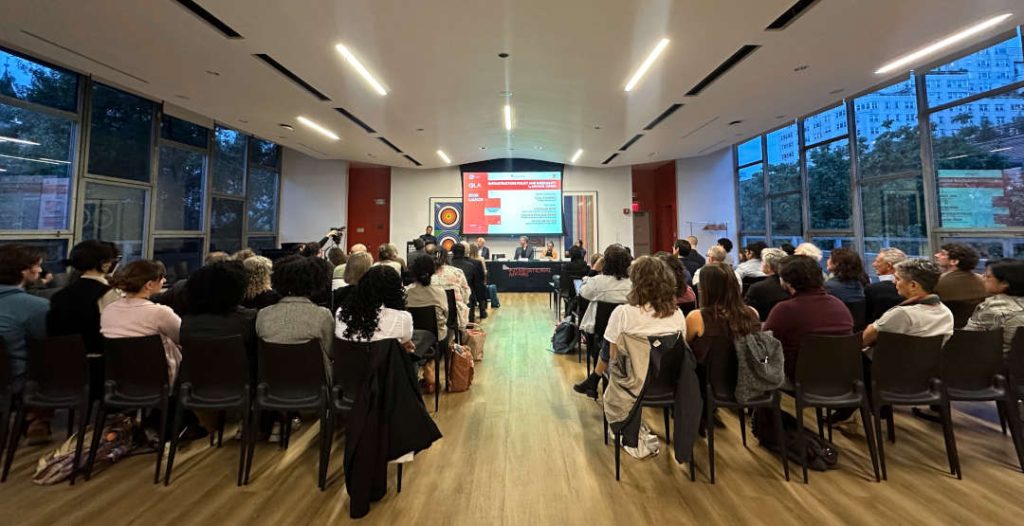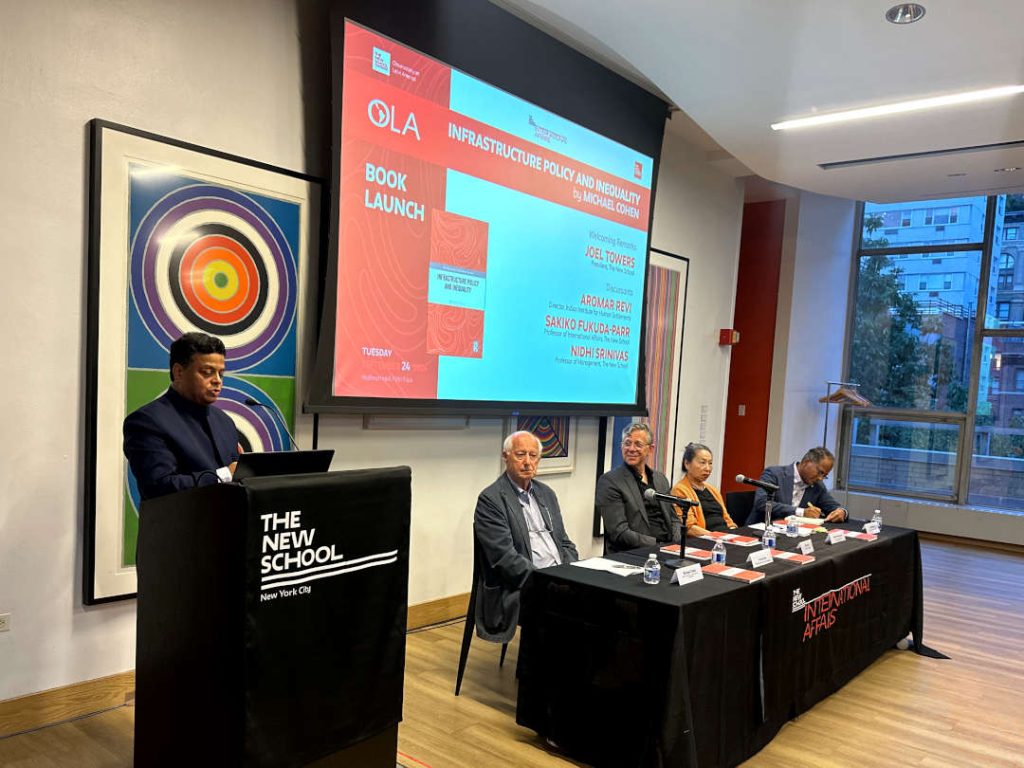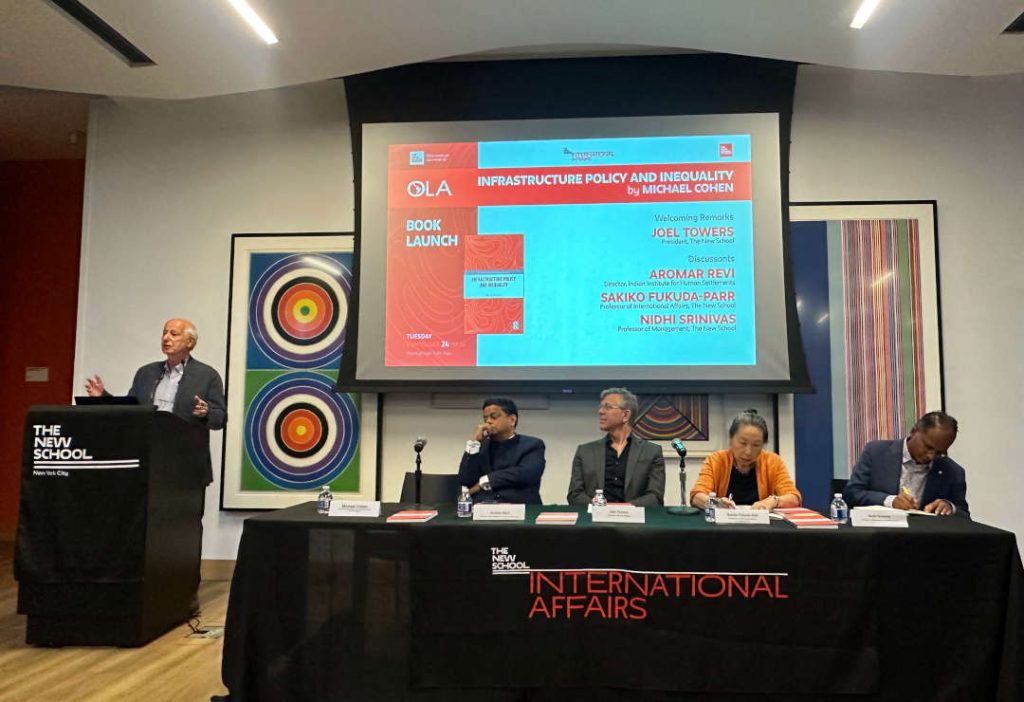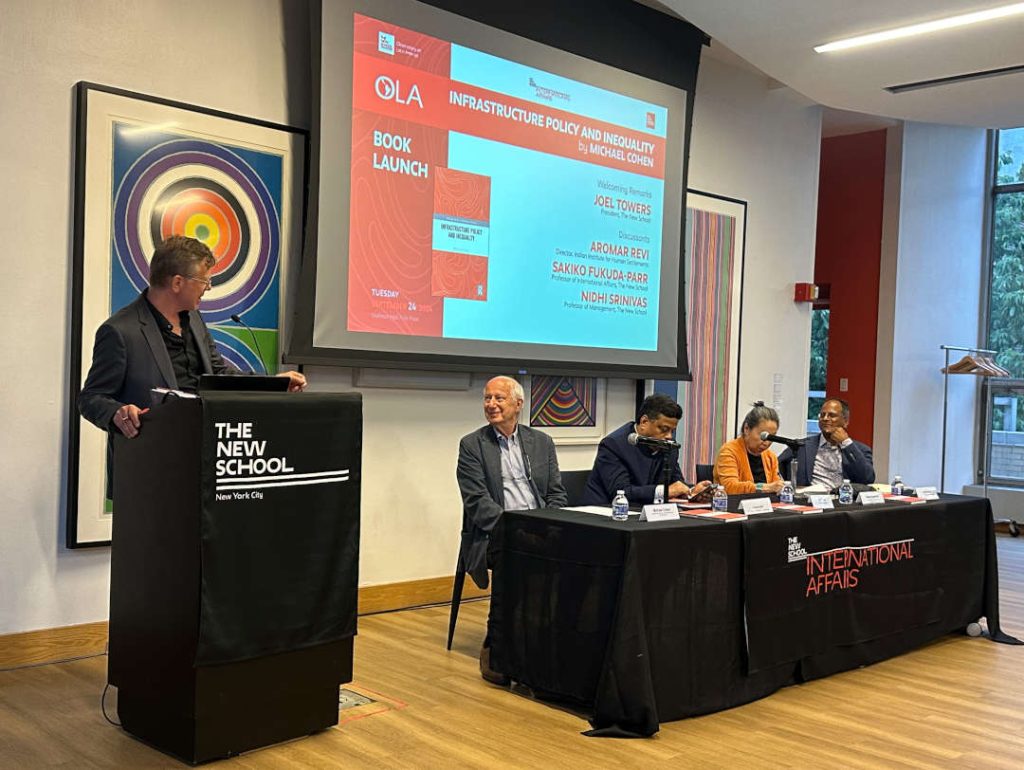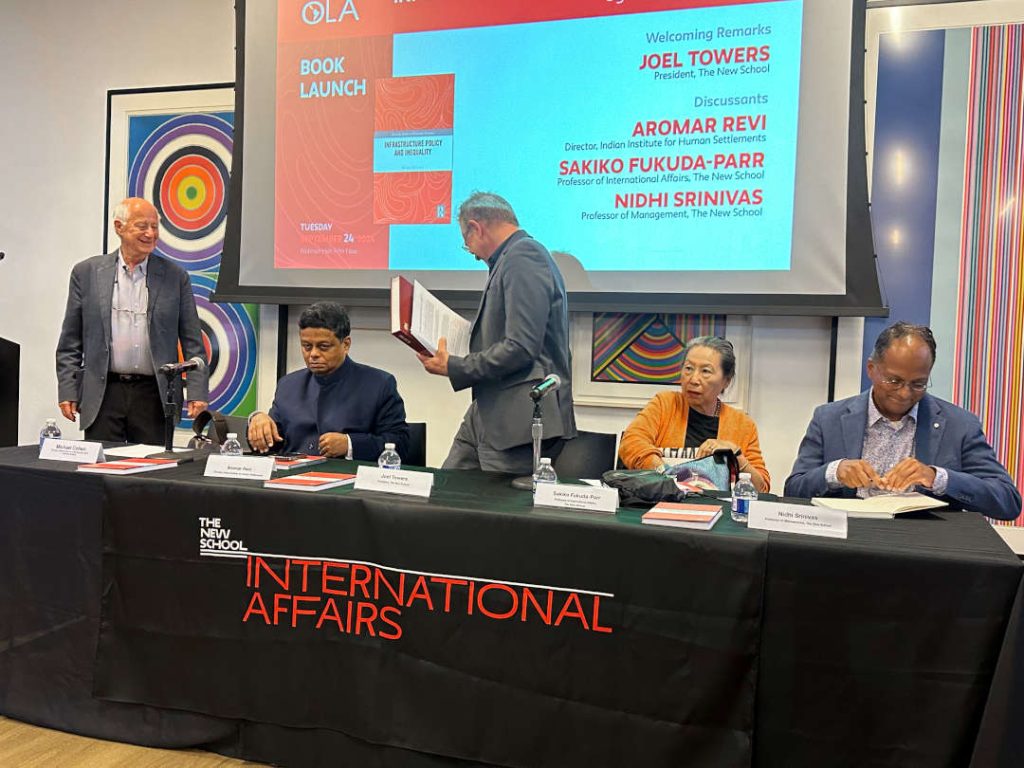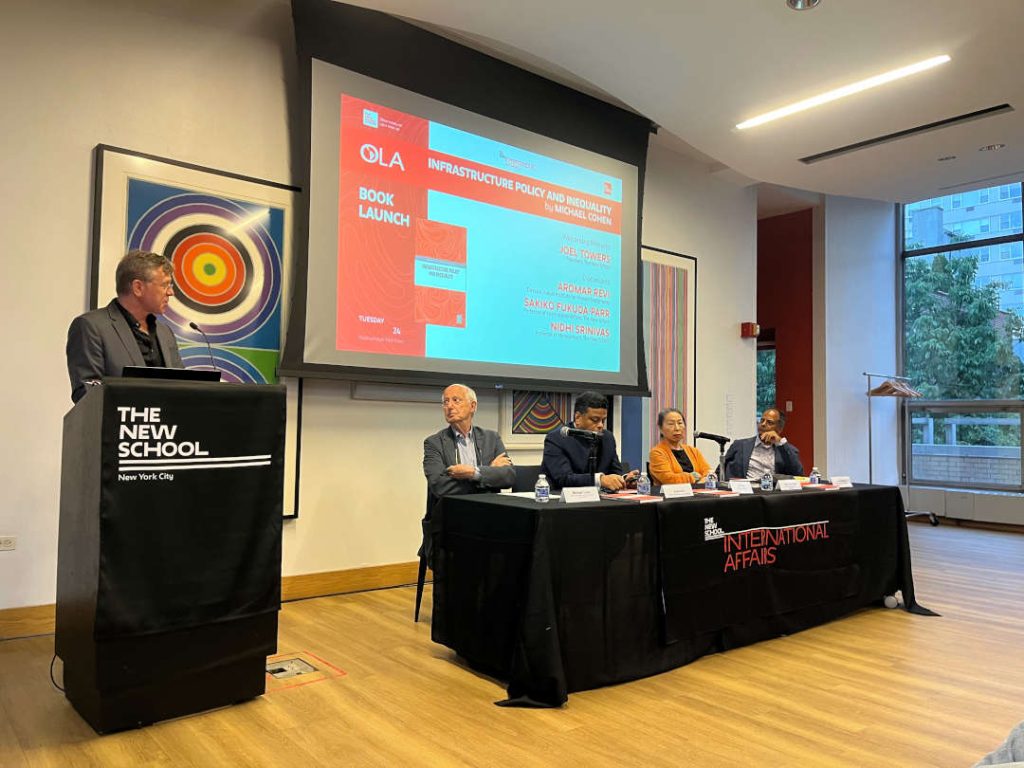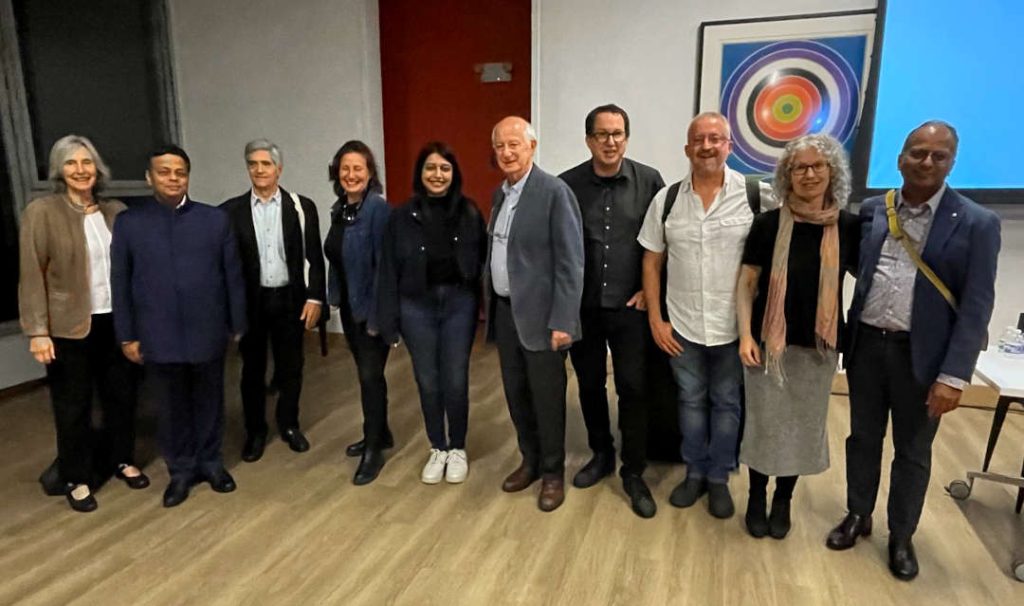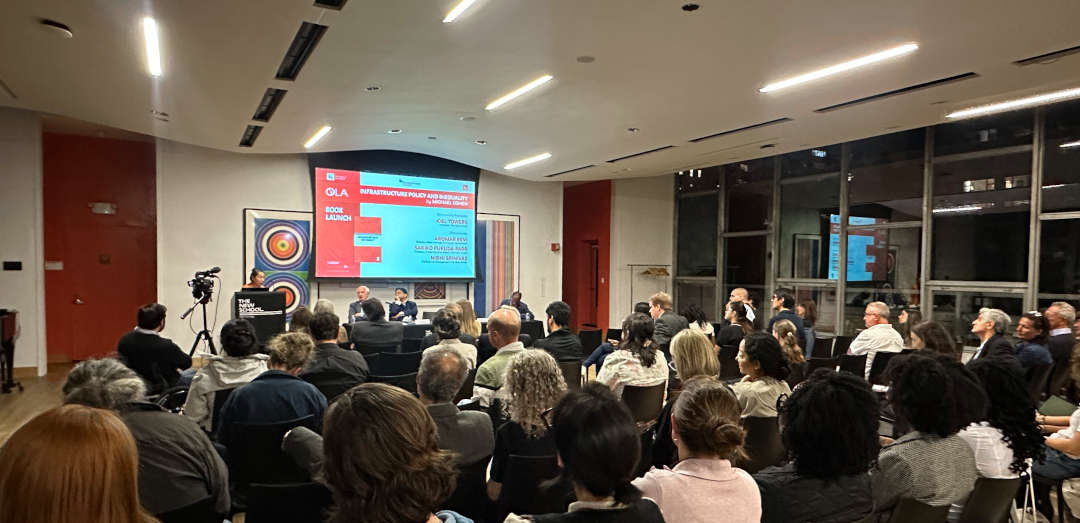
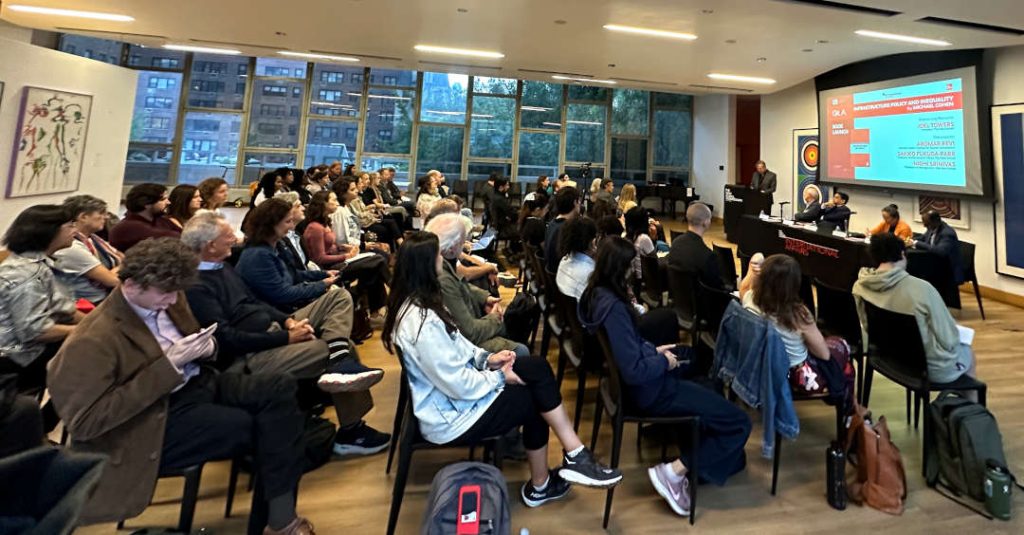
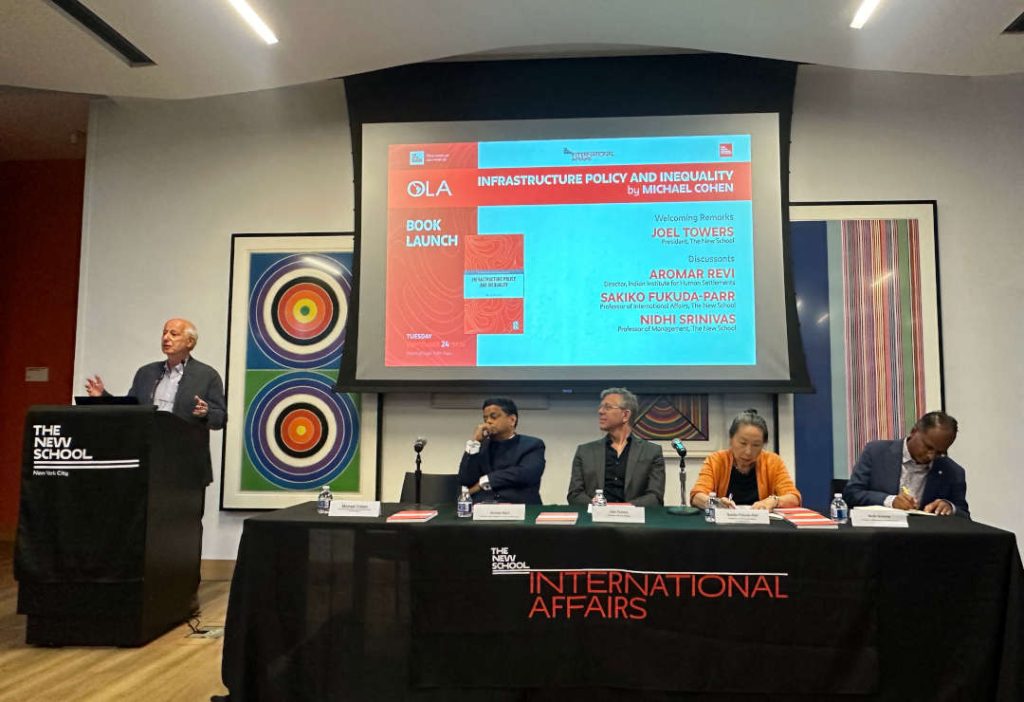
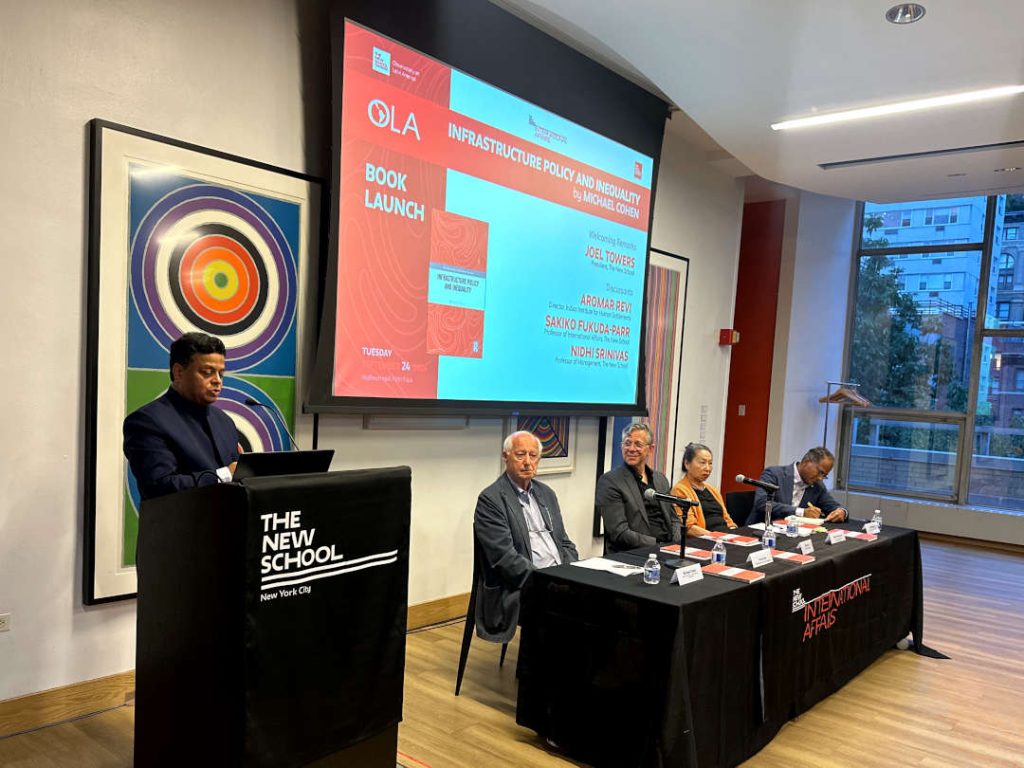
The Observatory on Latin America (OLA) hosted a book launch for the book Infrastructure Policy and Inequality by Michael Cohen on September 24, 2024. The event had welcoming remarks from Joel Towers, President of The New School and Michael Cohen, Director of the Doctoral Program in Public and Urban Policy at The New School and Co-Director of the OLA. They were followed by a discussion about the book, which included expert panelists: Aromar Revi, Director of the Indian Institute for Human Settlements; Sakiko Fukuda-Parr, Professor of International Affairs at The New School; and Nidhi Srinivas, Professor of Management at The New School.
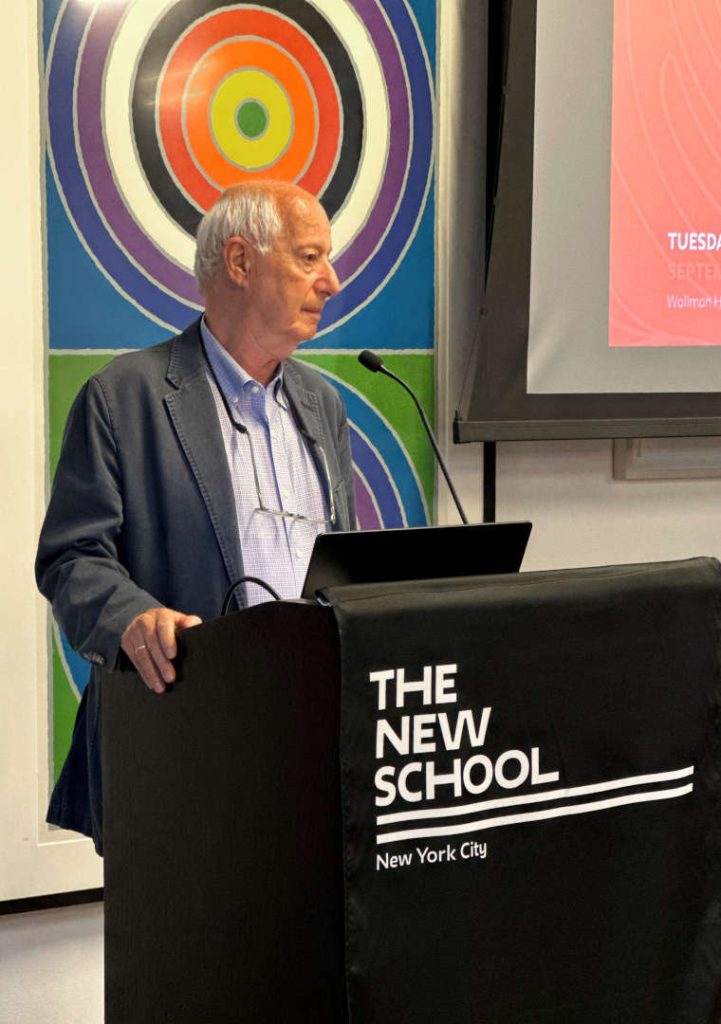
Joel Towers introduced Professor Michael Cohen, emphasizing his extensive career in urban policy and his prominent role at The New School. He highlighted that Professor Cohen’s new book stems from three main motivations: to share lessons from his career, to reshape how we consider infrastructure in a post-COVID world, and to promote infrastructure as a tool to address the structural inequalities spotlighted by the pandemic and movements like Black Lives Matter. President Towers mentions that aligned with The New School’s mission to connect academic inquiry with contemporary social challenges, Professor Cohen’s work advocates for reconceptualization of infrastructure beyond engineering, emphasizing that economic growth is a necessary but insufficient condition for countries to achieve social justice or sustainability.
Following this introduction, Professor Michael Cohen begins his remarks by sharing his motivation for writing the book: evaluating public action. He focuses on his journey into the world of infrastructure, aiming to reframe how we think about it, not as mere construction projects for economic growth but as deeply impactful processes that can either perpetuate inequality or foster real social change. Drawing from his decades at the World Bank, he describes a specific experience in Senegal, where what appeared to be a setback in development eventually brought lasting benefits to the community, urging his audience to consider long-term impacts beyond immediate economic gains. Coupled with other experiences mentioned in his intervention, he emphasizes that infrastructure should be designed with people at its core and valuing local knowledge, focusing not just on growth but on who truly benefits. He warns that without a shift in priorities, public infrastructure may continue to overlook communities that need it most. For this reason, we need to value projects that address inequality, that are accessible and sustainable, and that genuinely serve the public rather than relying on profitability as the primary measure of success. He hopes to inspire a more just approach to development through his reflections, where infrastructure becomes a tool for equity.
The first speaker of the discussion panel was Aromar Revi, who highlighted the critical role of infrastructure in tackling urban inequality, particularly in emerging economies like India, but emphasized that infrastructure alone cannot resolve these issues. He argues that while infrastructure is foundational, it must be accompanied by integral services such as healthcare, education, food, and clean water to be effective. Revi highlights how urban challenges, like inequality, must be understood not only economically but also through gender, caste, and ethnicity. He reflects on India’s infrastructure and urban development, noting how investing in services rather than mere infrastructure can reduce inequality. He underscores the importance of empowering communities, citing India’s recent large-scale projects. Challenges in financing for the poor, land access, and urban poverty are also discussed, with infrastructure linked to poverty alleviation if community voices guide planning. Finally, he mentions that, despite their economic potential, urban areas often centralize poverty and ecological risks, underscoring the need for regional ecological and infrastructure planning to sustain urban development.
The second panelist, Professor Nidhi Srinivas, explored Professor Cohen’s approach to infrastructure as a social process that shapes and can potentially reduce inequality through social justice. He examined the World Bank’s role, referencing Robert Hunter Wade’s argument about ideological shifts at the Bank in the 1980s. He questioned how Cohen’s position reflected his commitment to social justice versus the World Bank’s typical ideology. Professor Srinivas also discussed the state’s evolving role in urban development and the impact of the World Bank’s relationship with parastatals. The conversation then addressed infrastructure’s potential to contribute to inequality, mainly when framed as private property. He questioned whether urban infrastructure should continue empowering people experiencing poverty as consumers or pursue alternative models, like de-growth. Lastly, Srinivas cited Professor Cohen’s anecdotes told in the book about Aboriginal involvement in Australian infrastructure projects and an encounter with Indian politician M.G. Ramachandran to contrast infrastructure’s potential for social cohesion with the reality of political systems that marginalize the poor, leaving the audience with contrasting images of political possibilities.
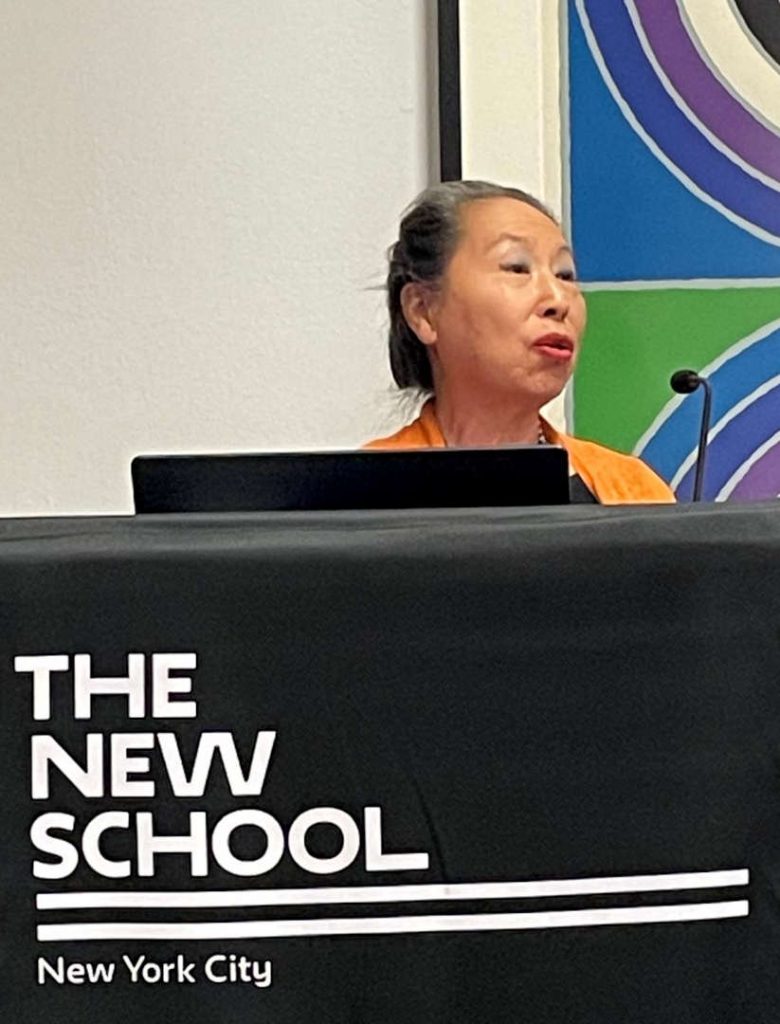
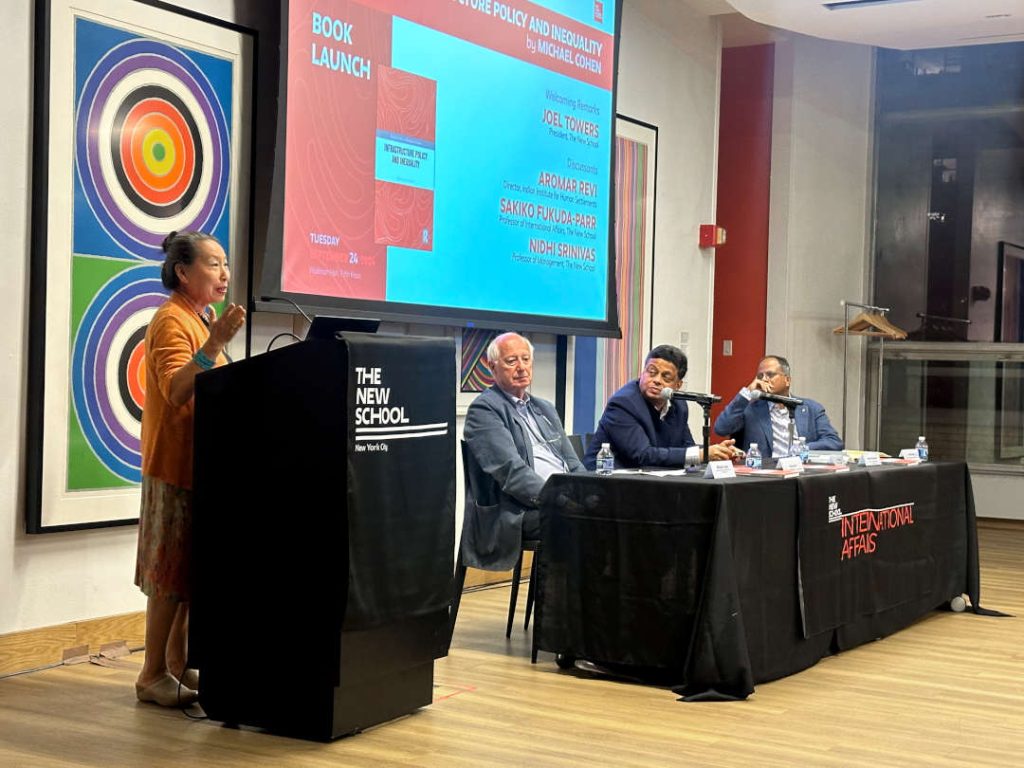
Professor Sakiko Fukuda-Parr, the closing panelist, stated that the book was both a profound analysis of urban policy and a personal narrative of Professor Cohen’s journey within the World Bank. Drawing from her own experience as a former World Bank staff member, she praised the book’s rare ability to capture the evolution of World Bank policies on urban development, shaped not only by leadership but also by the work of middle-level bureaucrats. Professor Fukuda-Parr commended Cohen for challenging conventional wisdom and pushing for new ideas, emphasizing the intellectual rigor and commitment of development professionals. The panelist reflected on the shift in development thinking from technocratic solutions to more complex, multi-sectoral approaches, while acknowledging the limitations of professionals within institutional constraints. She then critiqued the donor-driven nature of development aid, arguing that it should not focus solely on economic growth, and praised Cohen for presenting a balanced view on how professionals can still create meaningful change despite challenges.
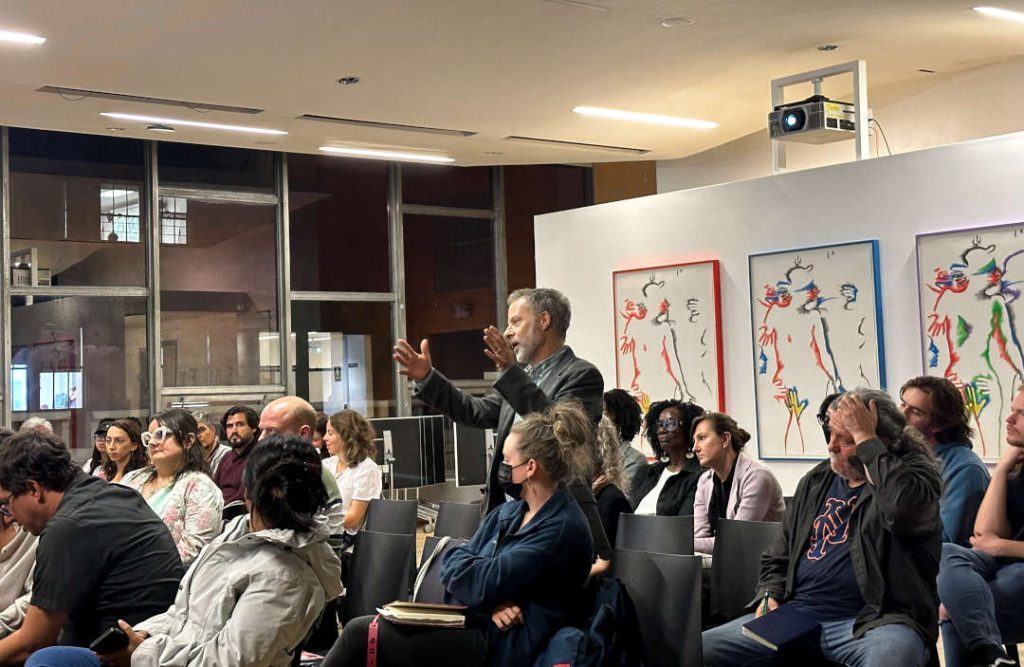
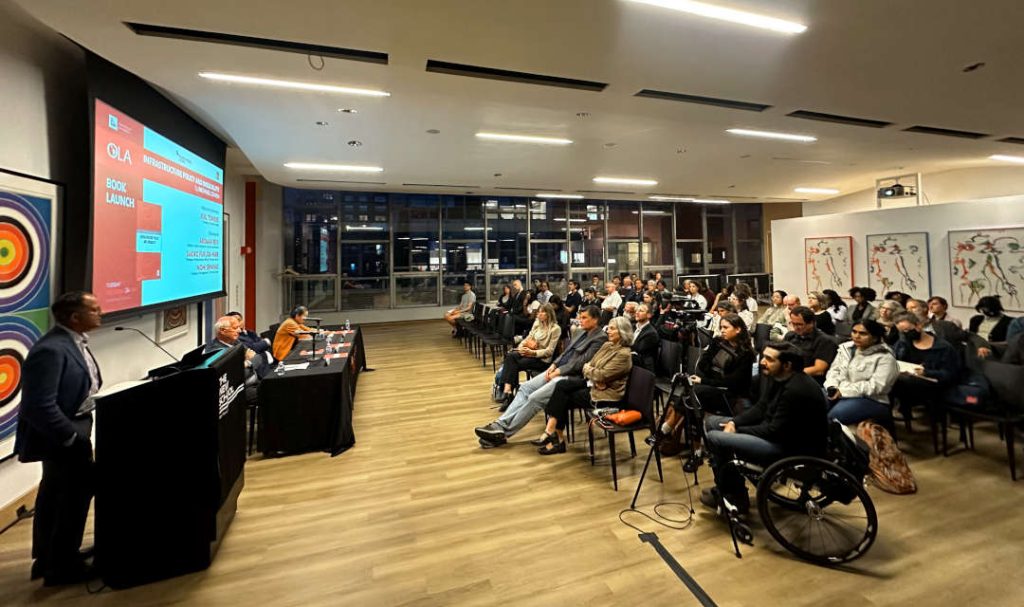
After the panelists concluded their interventions, they engaged with the audience through a series of questions and debates about the subjects discussed during the evening.