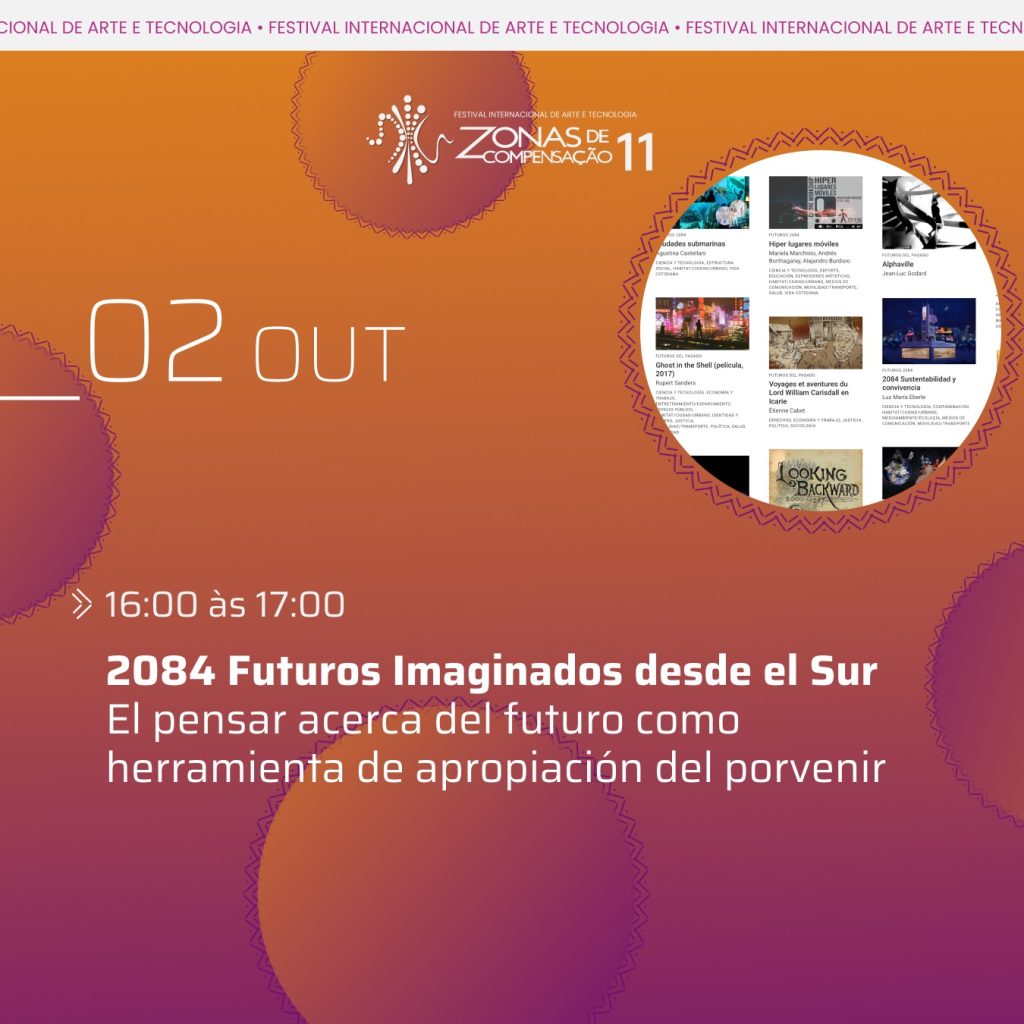
On October 2nd, the 2084 Imagined Futures from the South program participated in the Zonas de Compensação International Art and Technology Festival 11: Vetores de Imersão e atalhos para mundos imaginários (Compensation Zones International Art and Technology Festival 11: Vectors of Immersion and Shortcuts to Imaginary Worlds) organized by GIIP – Grupo Internacional e Interinstitucional de Pesquisa entre ARTE, CIÊNCIA E TECNOLOGIA, Instituto de Artes – SP, UNESP – Universidade Estadual Paulista “Júlio de Mesquita Filho”.
The online presentation began with Amanda Jorri (Brazilian Research Assistant at OLA) who outlined the history, foundations, and objectives of this program organized by the Latin American Observatory (OLA) of The New School. Amanda concluded by stating that the 2084 program does not offer us prefabricated answers but rather poses fundamental questions. For example, how can we guarantee that all people have the right to imagine their future? How can we transform those dreams into concrete actions in the present? And perhaps most importantly: if official and dominant futures do not reflect the diversity of human experiences, isn’t it time to change the way we think about and plan our futures?
Watch the video
Next, Martín Gromez offered a tour of the website www.2084futurosimaginados.org, highlighting the Museum of Futures, which allows visitors to participate by uploading their own imaginings and reflections about our futures. He also mentioned the creation of “Visitas Guiadas” (Guided Tours) in which visitors can curate/select and group imaginations, sharing their perspectives and opinions on the content (the imaginations hosted in the Museum’s collections). He emphasized that the Museum of Futures is a rich online database accessible to researchers and anyone interested in the matter of futures. He also provided an overview of the “Columns of Futures” section, which features reflections by authors who from their different places of manoeuvre activate, dialogue, inform and spread the issue of “futures” related to our compatriots who inhabit the Global South.
Finally, Juan Manuel González, the program coordinator, gave a brief introduction to the futurism industry and contrasted it with the OLA’s 2084 Program, revisiting points previously raised by Amanda and Martin in their presentations. He reiterated 2084’s objective: to invite ordinary people to think about futures related to aspects of daily life, and the intention to collectively discuss and reflect on these imaginings—why these particular ones, and what assumptions and references inform them.
Juan Manuel raised three points: 1) a felt urgency to collectively imagine futures in ways different from those of the futurism industry, in order to promote new possibilities and new paths; 2) the question of whether we can/should imagine different futures using the same languages and tools that have been used to construct current worlds; and 3) an assertion that the “broadness” of the futures people imagine varies greatly and depends on many factors and circumstances. The ability to project into the future varies from person to person, and this is something to consider in collective exercises of this kind.
The presentation concluded by mentioning the alignment between the 2084 Program and GIIP’s interests, and especially with the Zonas 11 call for proposals, the framework for this event.
This encounter opened space for a new partnership with UNESP, as both participants and organizers expressed great interest in contributing to and engaging with our broader agenda on futures, imagination, and social transformation.”
Tags: 2084, Activities, Brazil, Decolonization, Event Summary, Future, Online, Presentation