
• OLA
    • About the OLA
    • Who we are
    • International Cooperation
  • Programs
    • 2084 Imagined Futures
    • Conflicts in the Digital Space
    • Latin America on the Move
    • Design and Development
      • SDG and NUA in Buenos Aires
      • Habitat in Debt
    • New urban practices
      • Urban resilience in Latin America
      • Evaluation of neighborhood improvement
    • Cuba
    • Past Programs
      • Building Bicentennials
      • PNK Fellowship
      • Space of the Grandmothers
  • Media & Publications
    • Books
    • Articles
    • Working Papers
    • Press
    • Videos
  • News
  • Eng
  • Spa

Metadata RoundTable: Dilemmas of data construction processes. SI + Keywords Conference

Nov 8, 2021 | Conflicts in the digital space, News, Programs, Videos

Metadata RoundTable: Dilemmas of data construction processes. SI + Keywords Conference

Authors:
Table Coordinators:

Margarita Gutman and Nicolás Quiroga

Exhibitors:
Emmanuel Borthiry, Emiliano Calomarde, Javier Nesprias, Marcelo A. Soria, Margarita Gutman, Martin Pablo Groisman, Milagros Dolabani, Nicolás Quiroga, Silvana Ferreyra, Wanda Juares and Ximena Puppo.

Link:
https://youtu.be/j8nP057sUno

Summary:
Mateo Pasquinelli described the (future) society as the metadata society, understanding this term as a device of control and subjectivity. The simplicity of the vulgate term metadata (“data on data”) retains social problems inscribed in long-term structural technical processes and in “digital” processes that, since the nineties of the 20th century, have amplified the struggles to make the information classification systems meaningful and “natural”.

At present, the opacity of complex algorithmic systems that work with large amounts of data through AI / deep learning and the naturalization of the circulation and consumption of data produced by large corporations of platform capitalism demand a critical look at metadata. The same requirement applies to the “black box” of programming and to the use of “shielded” algorithms in the analysis of information.

Exploring and reflecting on metadata opens up the possibility of denaturing an uninformed understanding of situations that are presented to us as objective, universally accepted or definitive.

One example, among many, is the one presented by the images of Google Street View. These are intended to represent the visualization of a tour through the streets of the city at a given moment, which we assume is the one that appears in the shot that we observe. However, a more detailed search shows that this visualization, although it corresponds to the streets in question, is made up of shots taken at different times. In other words, the images that are presented as a synchronous visualization of the state of some streets, actually constitute an asynchronous composition. In this way, the understanding of the temporality of the representation is altered, which, although it may be irrelevant in some cases, in others may be decisive for decision-making or for the course taken by an analysis process.
The analysis of the metadata, which could be considered as a retracement of the data construction process, is crucial for the understanding of the production, circulation and pregnancy in social life of the algorithms that organize information in our present.

Convinced of this imperative, the table proposes to reflect on current research and future projects on methodological and political problems and dilemmas in research on data construction.

Presentations:
A look from the forges: building data, metadata, and annotations to train machine learning algorithms. The renewed potential of metadata

Marcelo A. Soria
(FAUBA, FCEN, UBA)

“PSYCHO / DATA / GEO / GRAPHICS”. Public space as a psychogeography of private data
Martin Pablo Groisman
(Expressive Media – Graphic Design, FADU – UBA)

(Self) learning processes of digital tools in social research: word clouds on Twitter
Emmanuel Borthiry, Emiliano Calomarde, Milagros Dolabani, Silvana Ferreyra and Wanda Juares
(INHUS, Conicet)

A messy world. Archiving, reading and algorithms in working with digital repositories
Nicolas Quiroga
(INHUS, Conicet)

Territories and temporalities of the digital city. Exercises to denature Google Street View and its data
Margarita Gutman, Javier Nesprias and Ximena Puppo
(Latin American Observatory, The New School – IEHu FADU – UBA)

Tags: Algorithms, Data construction, Digital processes, Digital Space, FADU UBA, Information classification, Metadata, News, Research, Urban Inequity

Events

0 events found.
There are no upcoming events.
Today

Latest Past Events

Oct 6 2026
October 6 @ 6:00 pm - 8:00 pm

Book Launch · The Tao of K-drama: Wise Narratives for a Troubled World

Wolff Conference Room 6 East 16th Street, New York

The inaugural volume in the Narrative Medicine series, The Tao of K-Drama is both scholarly and deeply personal. Drawing on Fullilove's work in community psychiatry and her lived experience as an African American woman, the book makes a compelling case for popular storytelling as a form of narrative medicine

Sep 24 2026
September 24 @ 6:00 pm - 8:00 pm

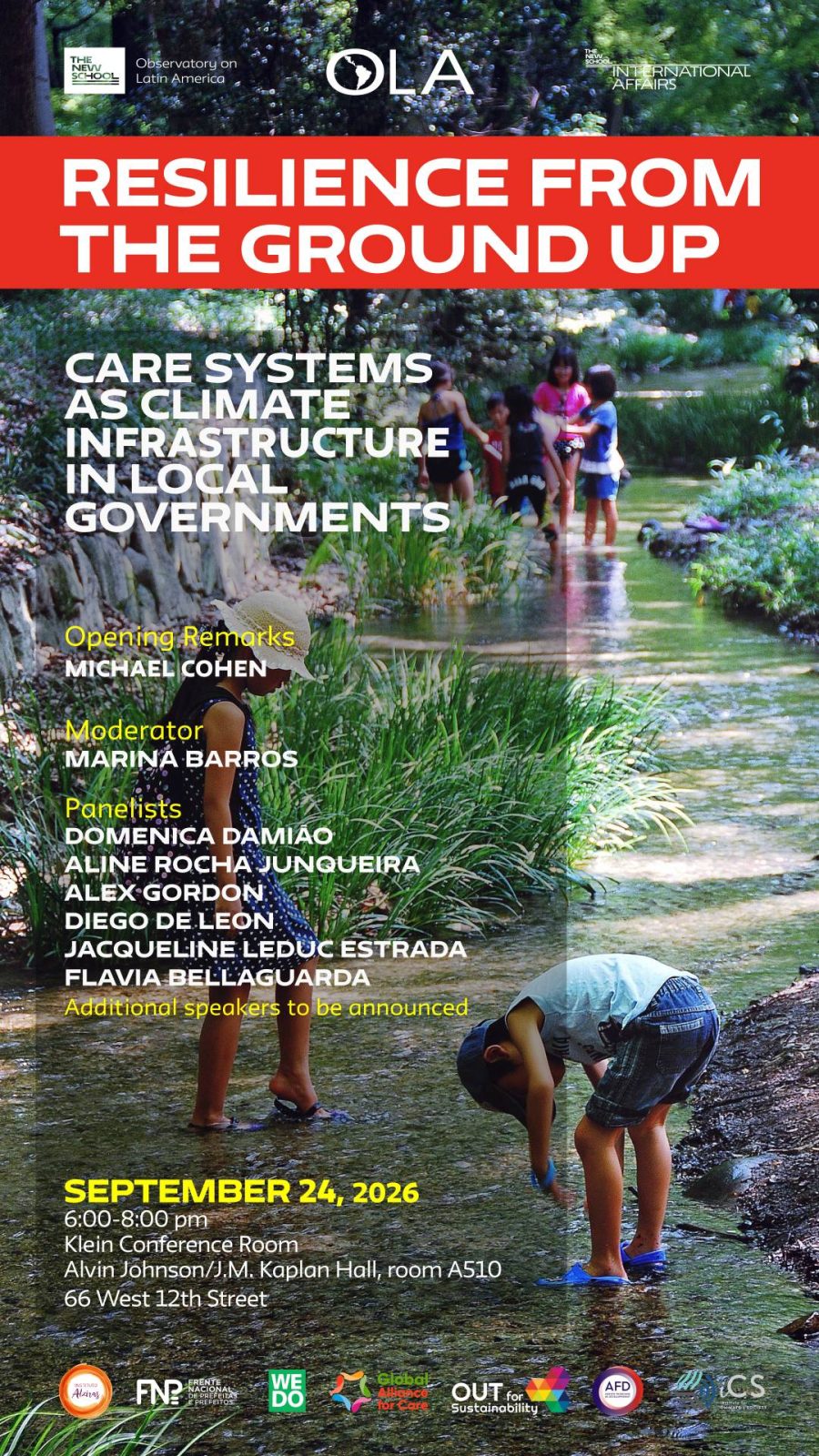
Resilience from the Ground Up: Care Systems as Climate Infrastructure

Klein Conference Room | The New School 66 West 12th Street, room 510, New York

This session explores how municipal care systems, ranging from community support networks and social safety nets to public health and caretaking services, function as critical, frontline climate infrastructure.

Apr 13 2026
April 13 - April 14

Uncertainty and Cities in 2026: Tariffs, Climate Change, and Politics

Room A404 66 West 12th Street, New York

This conference is “Uncertainty and Cities in 2026: Tariffs, Climate Change, and Politics” and will include perspectives from different international, national, and local institutions on the global economy and cities, and particularly the impact of the tariffs on urban economies and local governments in both the Global South and Industrialized Economies, the challenges of ...

Recent posts

  • Latin America at a Crossroads: Democracy, Economy, and Progressive Politics | Closed-Door Conversation with Axel Kicillof, Governor of Buenos Aires Province, Argentina · Event Summary
  • Resilience from the Ground Up: Care Systems as Climate Infrastructure · Event Summary
  • OLA 2026 Mid-Year Newsletter
  • Uncertainty and Cities in 2026: Tariffs, Climate Change, and Politics · Event Summary

The New School
66 West 12th Street
New York, NY 10011

Programs

  • 2084 Imagined Futures
  • Conflicts in the Digital Space
  • Latin America on the Move
  • Design and Development
  • New urban practices
  • Cuba

Projects

  • Habitat in Debt
  • SDG and NUA in Buenos Aires
  • Evaluation of neighborhood improvement
  • Urban resilience in Latin America

Media & Publications

  • Articles
  • Books
  • Press
  • Videos
  • Working Papers
  • Facebook
  • X
  • Instagram
Copyright 2023 © Observatory on Latin America | The New School | Desarrollo docke