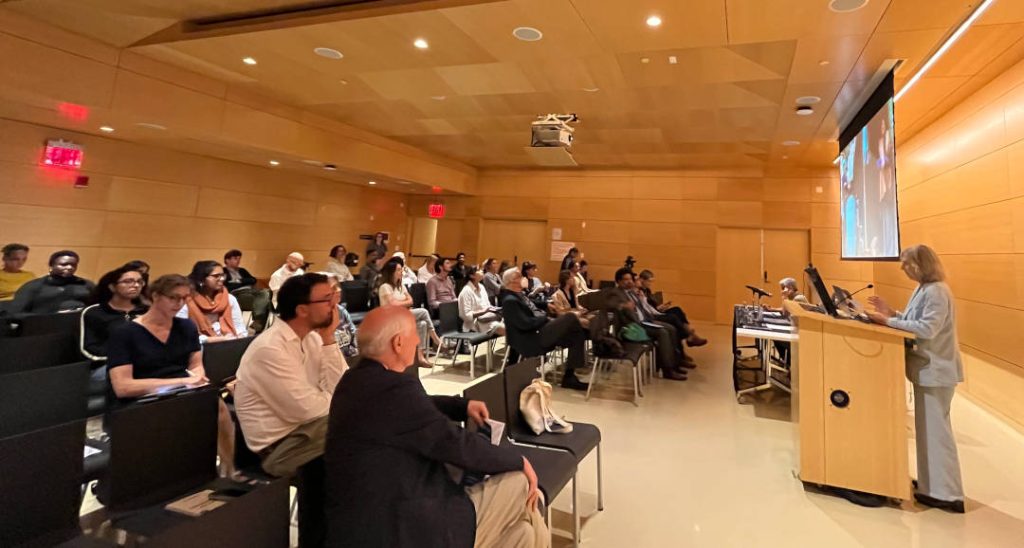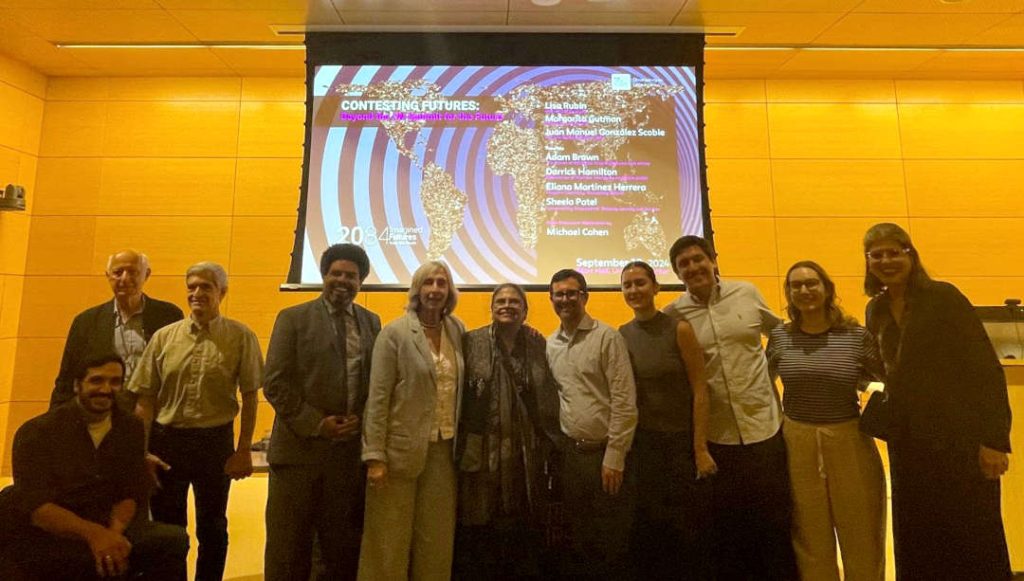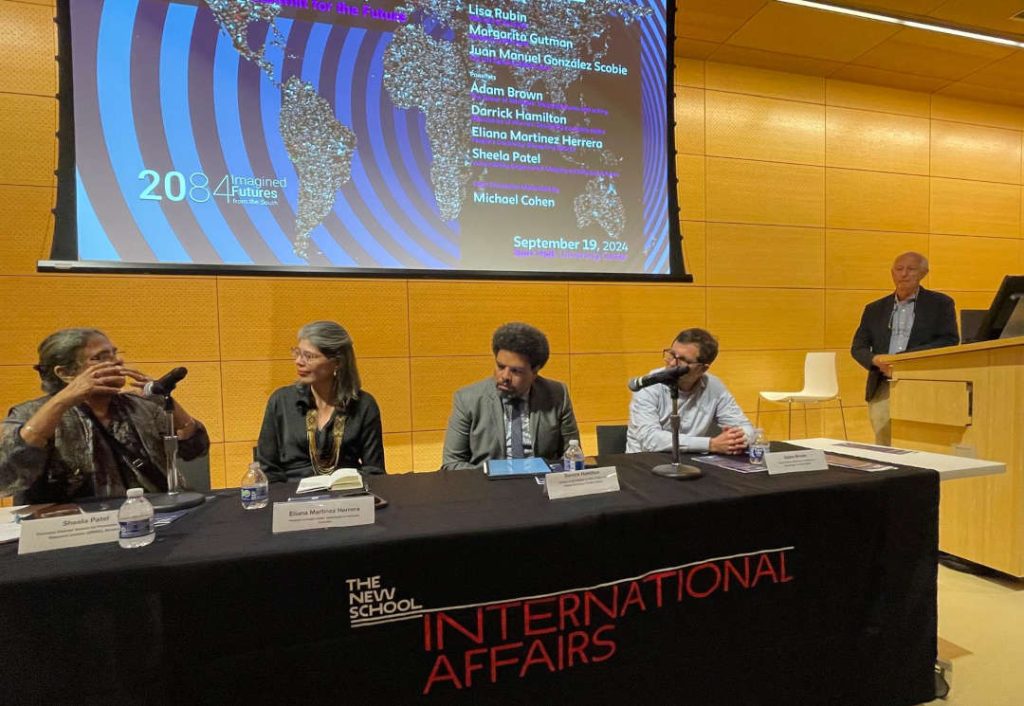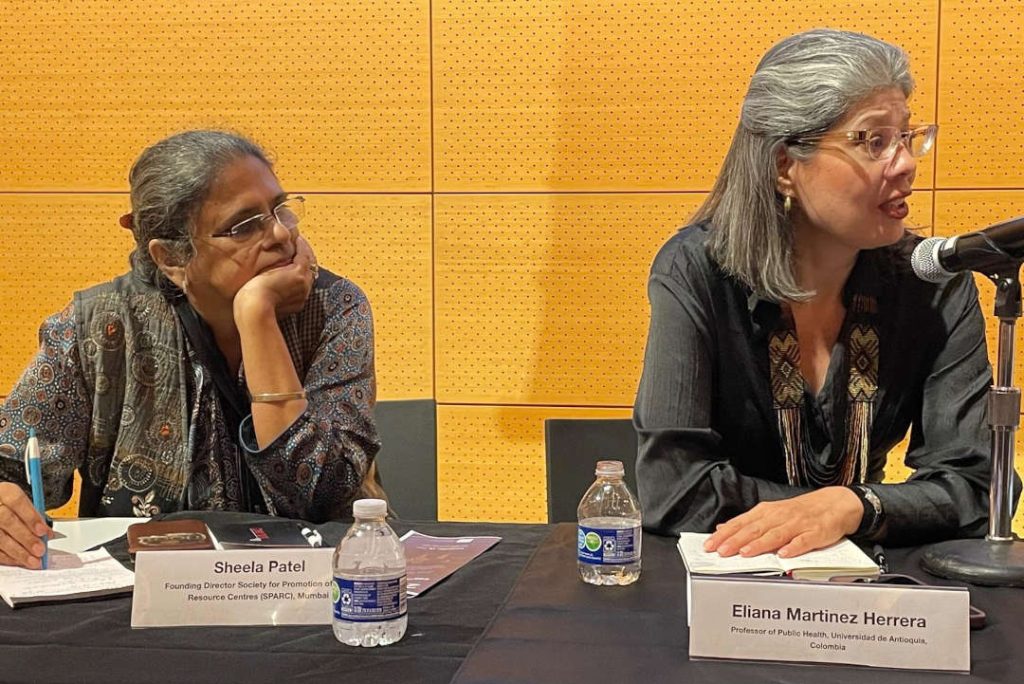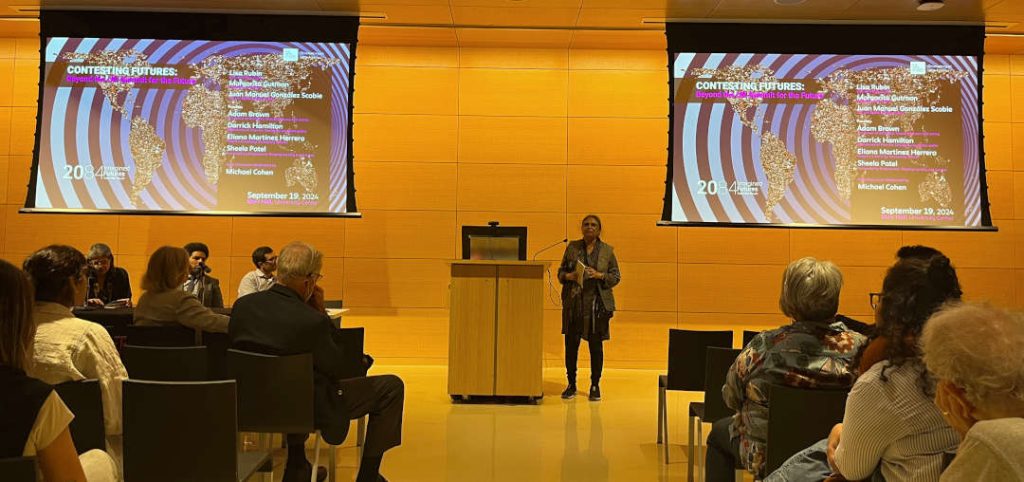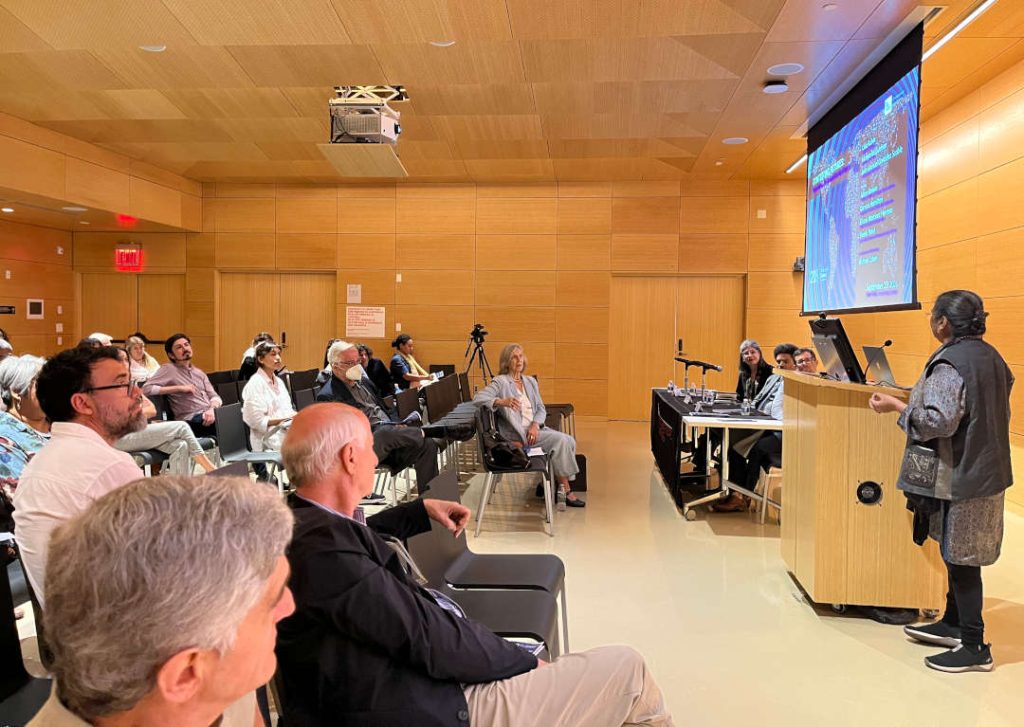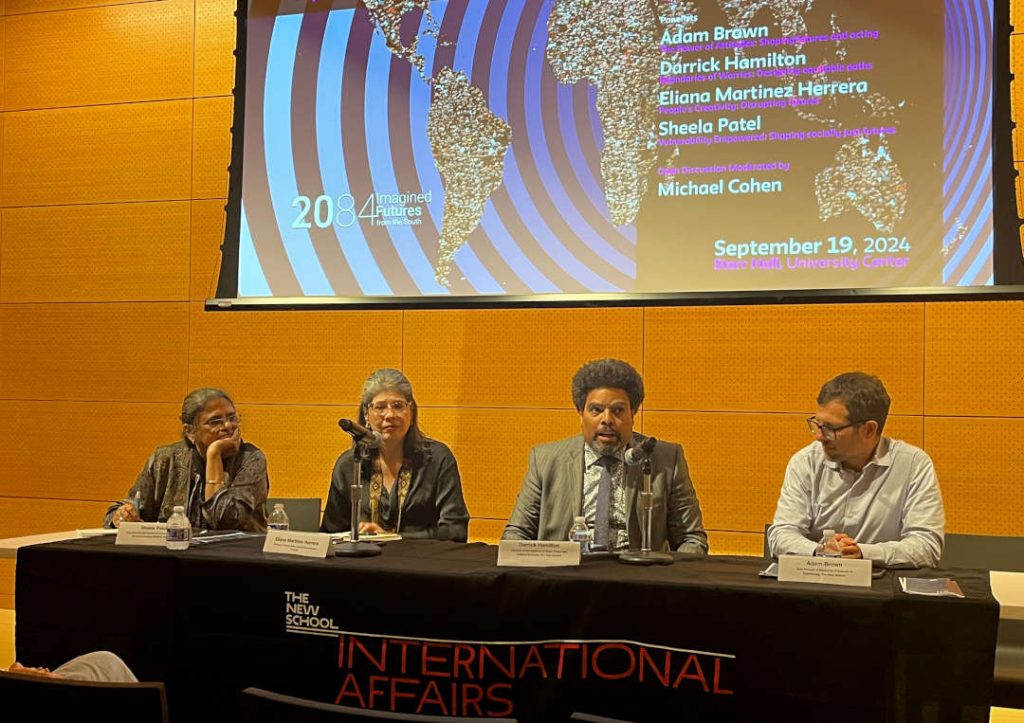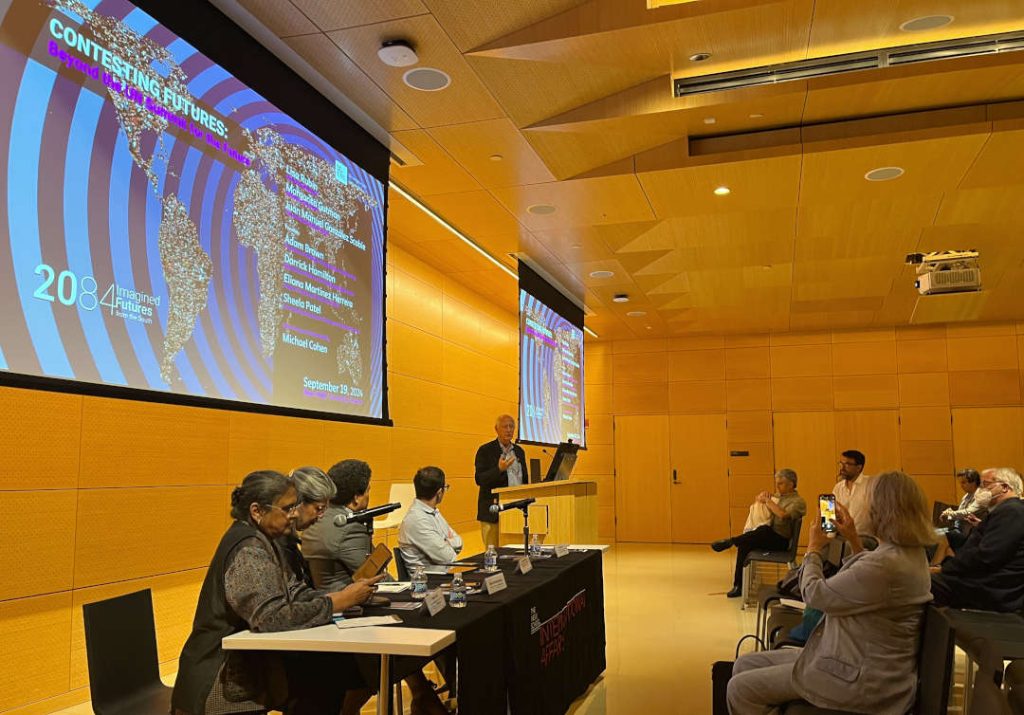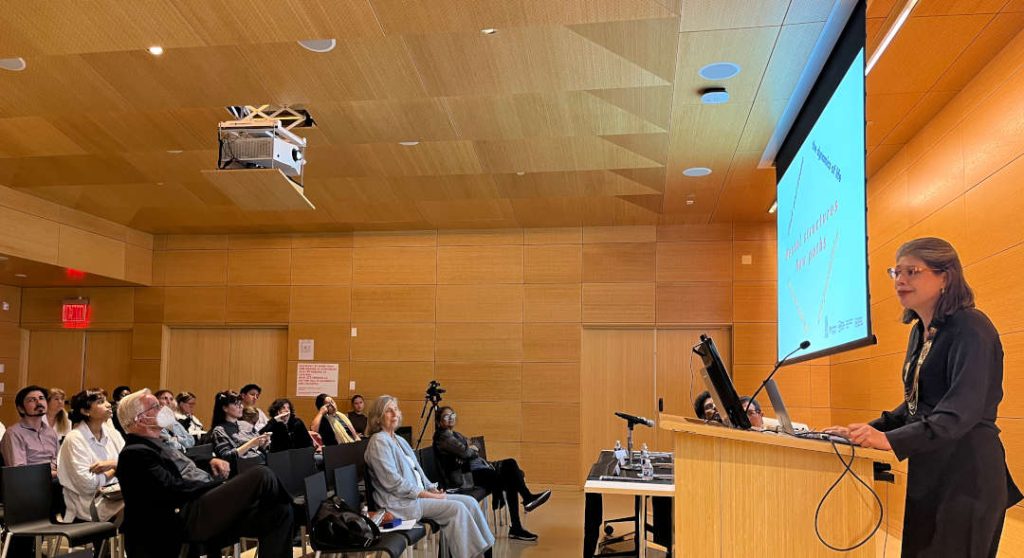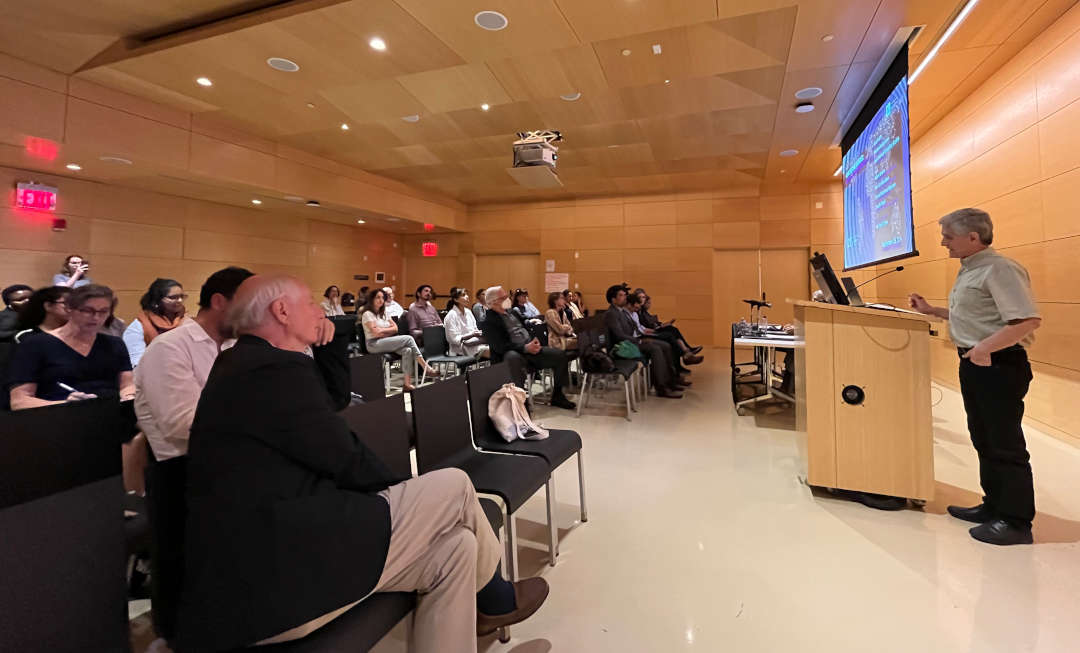
On September 19, the OLA held an event on “Contesting Futures: Beyond the UN Summit for the Future” as part of the 2084 Imagined Futures from the South program. The panelists invited for the event were Adam Brown, vice provost of research and professor of psychology at The New School; Darrick Hamilton, director of the institute on race, power and political economy at The New School; Eliana Martinez Herrera, professor of public health at Universidad de Antioquia (Colombia); and Sheela Patel, founding director of Society for promotion of area resources centres (SPARC) at Mumbai. The event also had the participation of Lisa Rubin, interim executive dean of the Schools of Public Engagement at The New School, who gave the welcoming remarks; Margarita Gutman, emeritus professor and co-director of OLA; Juan Manuel González Scobie, Senior fellow in the OLA; and Michael Cohen, director of the doctoral program in public and urban policy, and co-director of OLA, who opened discussions and moderated.
Lisa Rubin introduced the OLA, its relevance, and some of its achievements, such as publishing more than 15 books, numerous articles and working papers, and held more than 200 events. She emphasizes the commitment of the OLA and The New School to progressive education and public engagement.
Margarita Gutman presented the Contesting Futures event in the context of the 2084 Imagined Futures from the South program. She shared the guiding ideas and goals of the 2084: that the future is a contested terrain, and it must also be occupied through the participation of diverse groups of lay people, whose voices are not heard, whose expectations are not recognized.
Juan Manuel González Scobie introduced and problematized the UN Summit of the Future. He stated the three major concerns behind the organization and execution of the summit, which are the lack of effectiveness of international cooperation to adequately engage international challenges and problems, a lack of convincing and significant results in achieving the goals set in international agreements during the past decades, and the emergent new challenges for which the current multilateral governance architecture is not prepared. The speaker pointed out that their “future” is presented in singular, as if all peoples’ aspirations were the same and already defined. In this sense, he posed a few questions for discussion: What does the future mean for different people? Does everyone want the same? Are we all on the same path? Is imagining futures something to be delegated and entrusted to some agents, such as experts, political leaders, business people, scientists or others, or rather, should there be is something missing here?
The first speaker was Adam Brown, who discussed the role and the power of different people’s attitudes, possibilities and approaches in thinking about the future. He explores the role memory and history play in shaping what people generate at the individual level. When questioning ‘what role does memory play in these processes?” Adam Brown shows that people flexibly use the past to recombine the elements and print them into the future, which means that a lot of what goes into our future imaginings are things that we have already experienced. People with post-traumatic stress disorder, for example, not only had a very generalized kind of view of the past but also had a very similar style when imagining their future. Intergenerational memories also play an essential role in how young people project the future. He concludes that the future is diverse and heterogeneous.
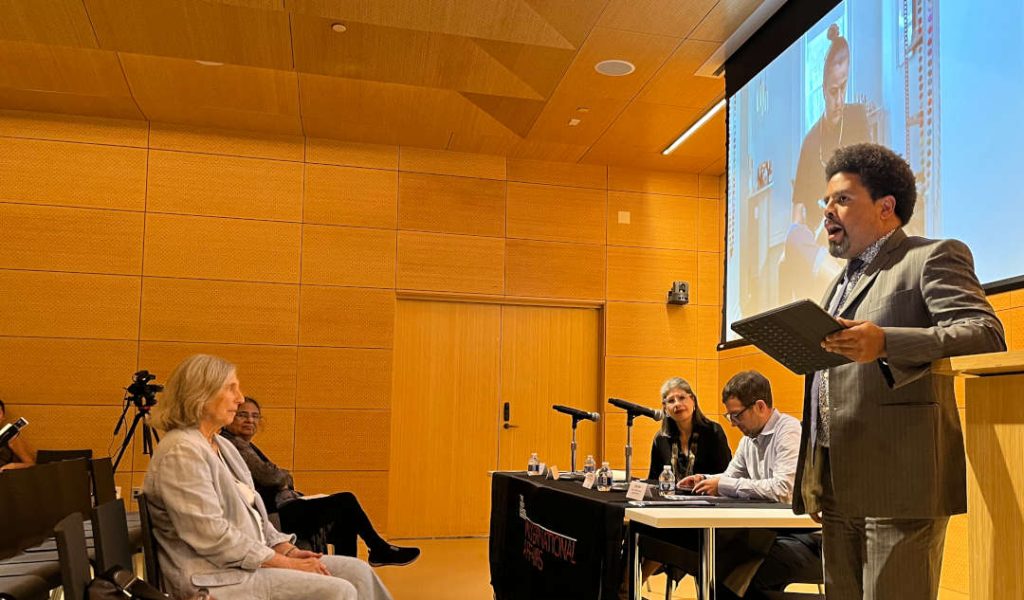
The second speaker, Darrick Hamilton, discussed boundaries and challenges in designing equitable paths. Through a video guided by the question “What is the purpose of the economy?” he argues that the economy should be reimagined with purpose in mind. The current way the economy works has yet to be defined in ways that promote the well-being of all people; it is exclusionary. However, the culmination of an economy that facilitates a hoarding of resources amongst a powerful elite has clear implications for our environment, democracy, and health. Hamilton’s speech claims that an economy that addresses exclusion recognizes history and engages multiple constituencies.
Watch the video presented by Darrick: https://vimeo.com/manage/videos/890454208/d2f66a68cc
Eliana Martinez Herrera was the third speaker. She discussed the topic of creativity and the importance of disrupting our views of the future. Eliana began her speech by stating that we do not have the answers for what lies ahead; instead, we face more questions about tackling our challenges. Building on Juan’s earlier remarks, she criticized the UN summit for the future, asserting that it was insufficient. She noted that while many professors are gradually incorporating ecological components into their work, there is a need for a more transdisciplinary approach. Eliana encouraged us to reflect on the question: “What do we need for disruptive futures?” She emphasized the importance of considering the health of our planet and the necessity to explore and rediscover new ideas. “What are the possibilities?” she asked, inviting us to think beyond traditional disciplinary boundaries and appreciate multiple perspectives. Eliana called for a transformation in how we view the world, highlighting the urgent need to integrate diverse voices and experiences.
As the last speaker, Sheela Patel addressed the themes of vulnerability and power in shaping a socially just future. She began by reflecting on her journey, which started when she began working with women living on the pavements of Mumbai. During this time, she realized how inadequate her education was and was deeply impacted by the imagery of poverty surrounding her. Patel pointed out that the objectification of those who are impoverished is a fundamental aspect of how development operates. Society often tells these individuals, who may have been marginalized, to feel apologetic for their circumstances. This attitude can also be extended to nations and states. She suggested that transforming these communities will provide insight into what the future should look like. Patel criticized the United Nations for its statements, which rarely translate into tangible benefits for people experiencing poverty, highlighting their invisibility in data. Moreover, she discussed a campaign she leads that empowers poor women to understand and claim their rights and entitlements. In closing, Patel called for a commitment to stand together, support, and learn from each other’s experiences.
Following the presentations, the audience engaged in a Q&A session, fostering a lively and dynamic exchange between attendees and the panelists. This conversation delved into a wide array of thought-provoking topics. This led to a dynamic conversation between several attendees and the panelists, covering topics related to colonization roots, political economy, technology, macro levels and structures, and human rights.